The Sierpinski triangle, Wikipedia, and the Sierpinski square also in Wikipedia, are fractals with the overall shapes of either an equilateral triangle or a square, subdivided recursively into smaller equilateral triangles or squares. Part I showed that a square could also behave similarly to afford a new type of fractal. The method of recursive subdivision was applied to a trihexagon Part IIa which then produced a Sierpinski triangle of hexagons and this in turn was being applied to an obstructed trioctagon in this paper to afford a new type of mingled (intermixed) fractal composed of three octagons and a rhombus/diboat structure. The technique employed, called the Droste effect, is the effect of a picture recursively appearing within itself much like video feedback.
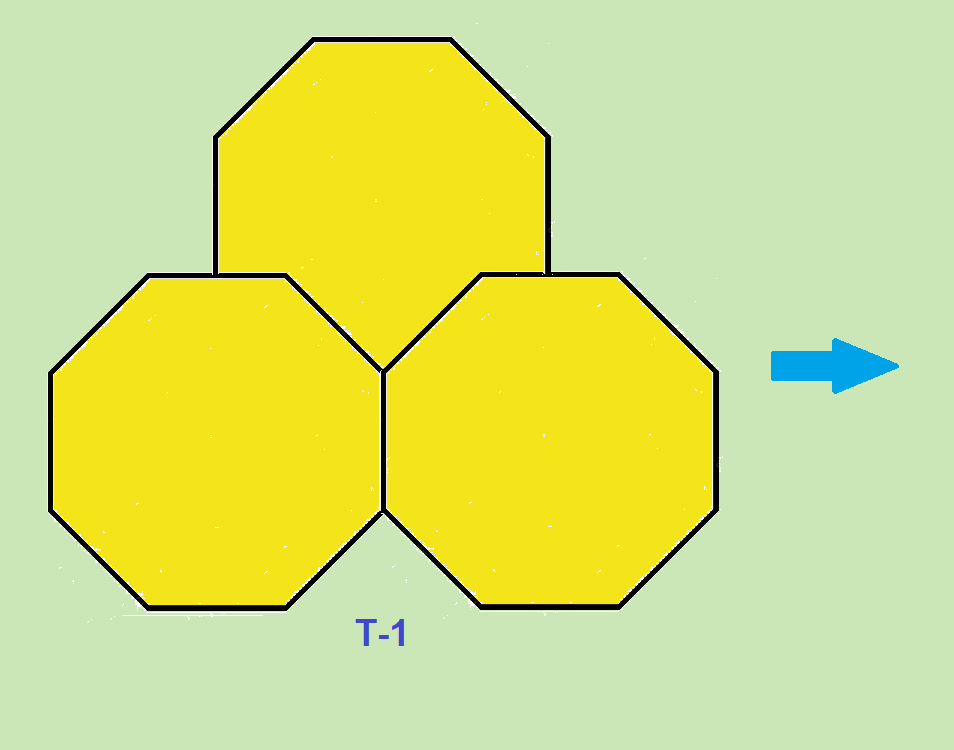
The figure to be subdivided is the following obstructed trioctagon. Why an obstructed trioctagon? Three hexagons can tesselate to give a tri structure. This isn't possible with with three octagons, where only two tesselate in the desired comformation. By placing the third octagon behind the dioctagon structure, where the two vertices of the obstructed octagon connect to the dioctagon as shown, it is possible to align all the smaller octagons generated by the Droste effect into straight lines to produce a Sierpinski triangle of octagons. Moreover, it has been shown that a non obstructed trioctagon can have the smaller octagons somewhat aligned, affording what appears to be a Sierpinski triangle as in the two trioctagon structures in Part V which also produces the Droste effect. :
Performing a first and second iteration of trioctagons affords the figure:
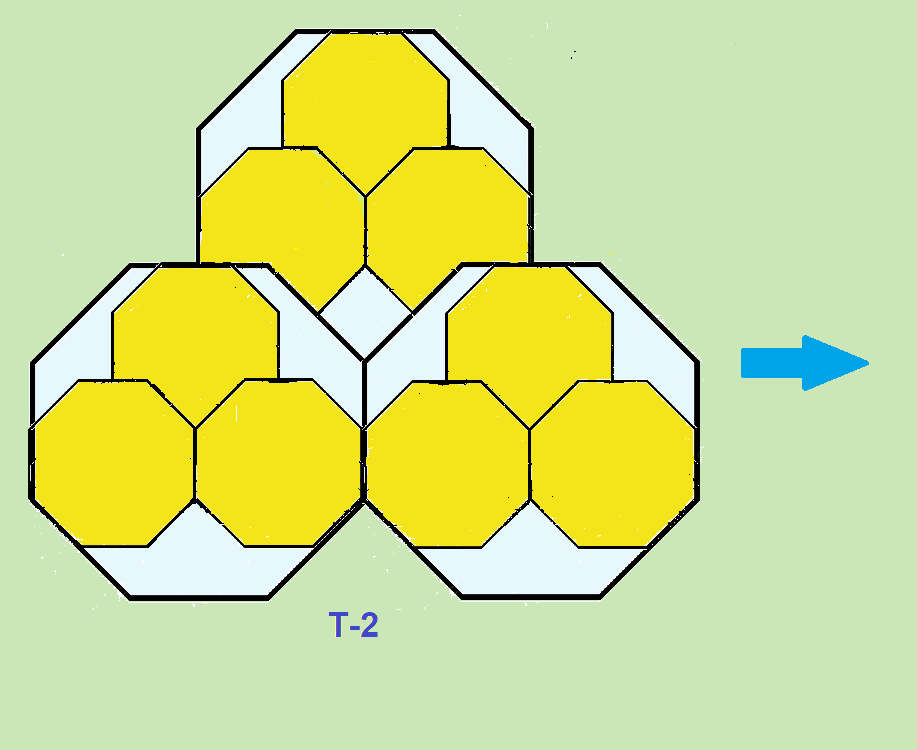
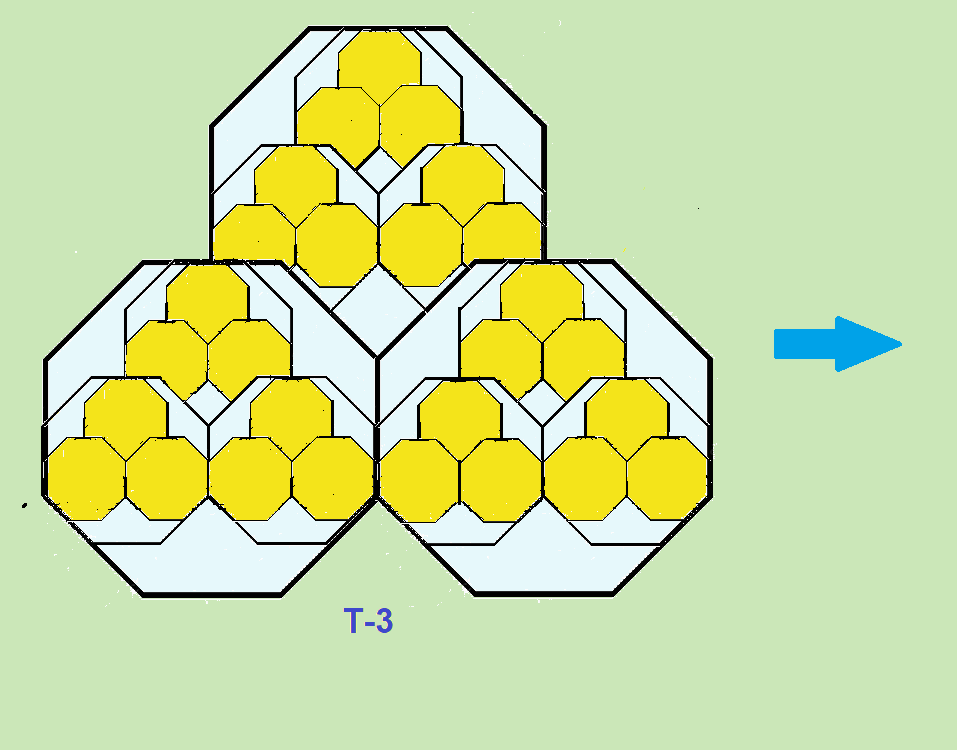
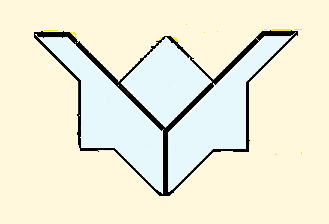
where in the holes where triangles should be, in the original Sierpinski, there is instead a rhombus/inverted two-boats which may or may not be present with other smaller boats in order to fill up the holes.:
Performing a third and fourth iteration of trioctagons affords the figure:
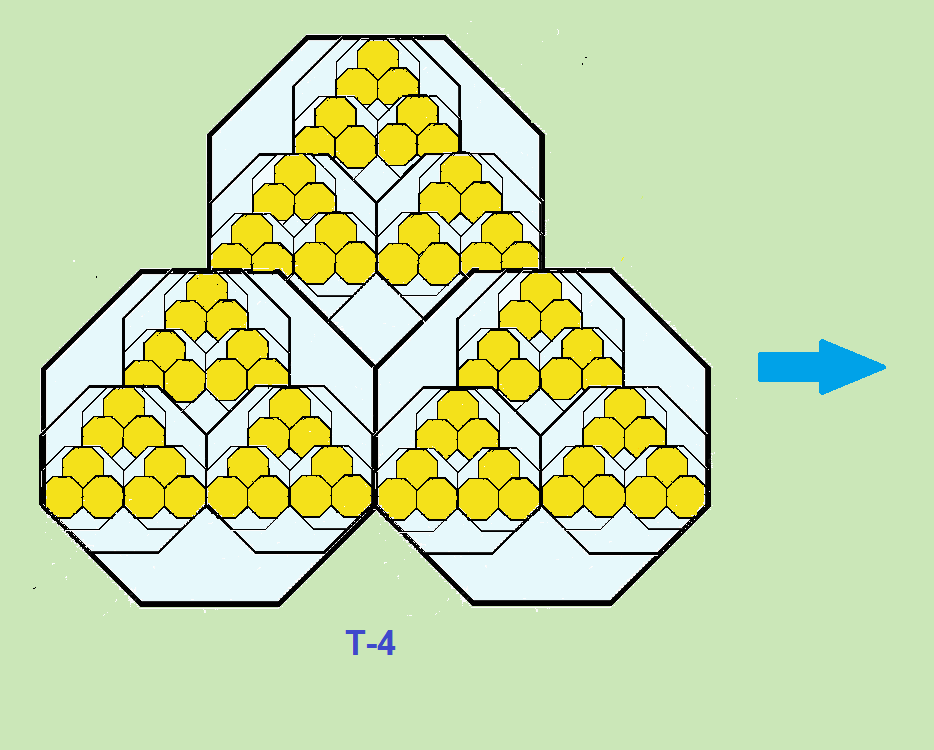
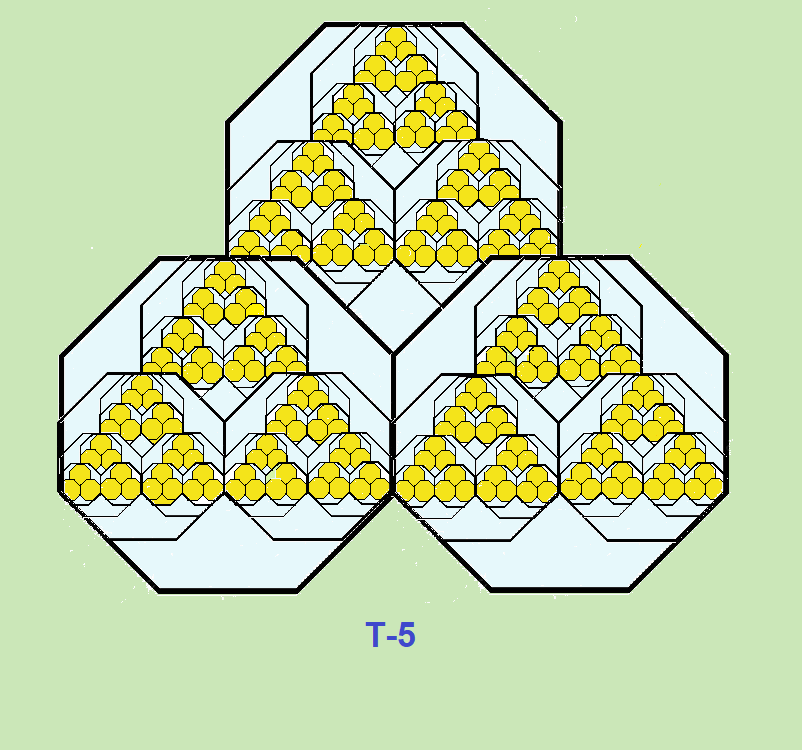
Expanding T-5 shows the rhombus/two boat decreasing in size as one goes further and further up the triangle. In addition, all the lines of each triangle are straight lines of octagons even though many of them may be obstructed.:
In addition, two non-obstructed Sierpinski trioctagons have been constructed in Part V which may be used as a comparison.
Go to Recursion of Part III dioctagon fused to an irregular hexagon.
Go back to homepage.
Copyright © 2026 by Eddie N Gutierrez. E-Mail: enaguti1949@gmail.com