The Sierpinski triangle, Wikipedia, and the Sierpinski square also in Wikipedia, are fractals with the overall shapes of either an equilateral triangle or a square, subdivided recursively into smaller equilateral triangles or squares. Part II showed that a hexagon could afford a new type of fractal via recursion. When the method of recursive subdivision is applied to two octagons fused to an irregular hexagon a new type of recursive structure is generated. The technique employed, called the Droste effect, is the effect of a picture recursively appearing within itself much like video feedback.
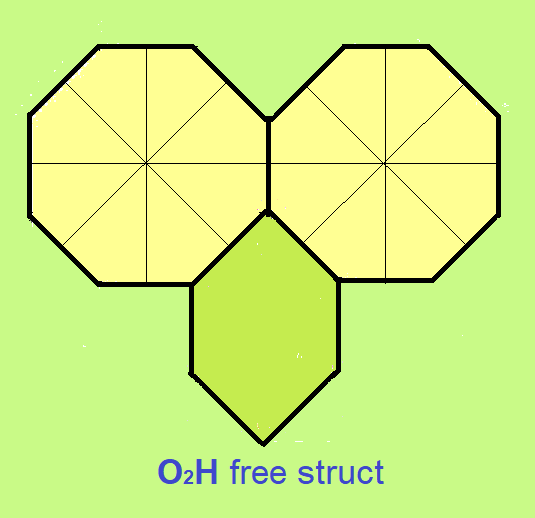
The figure to be subdivided is the following dioctagon/hexagon where the hexagon employed is irregular, having all sides equal to that of the octagons and whereby two of its angles are 90° and four 135°, the same as the octagons. This ensures that the three polygons pack into a structure that is capable of being tesselated.
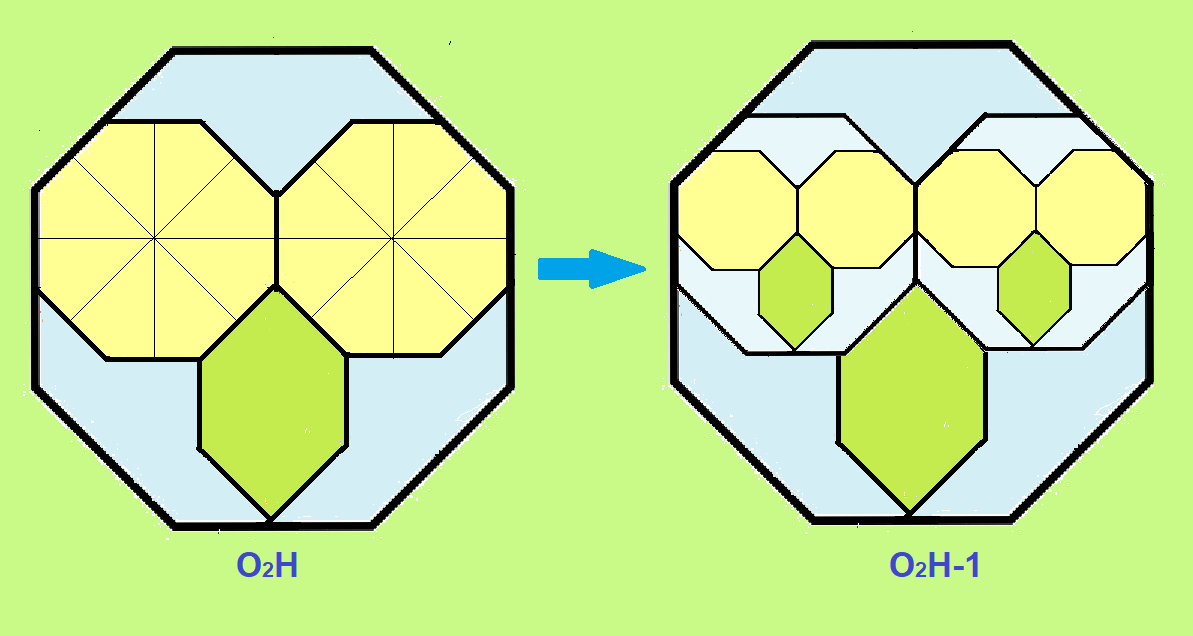
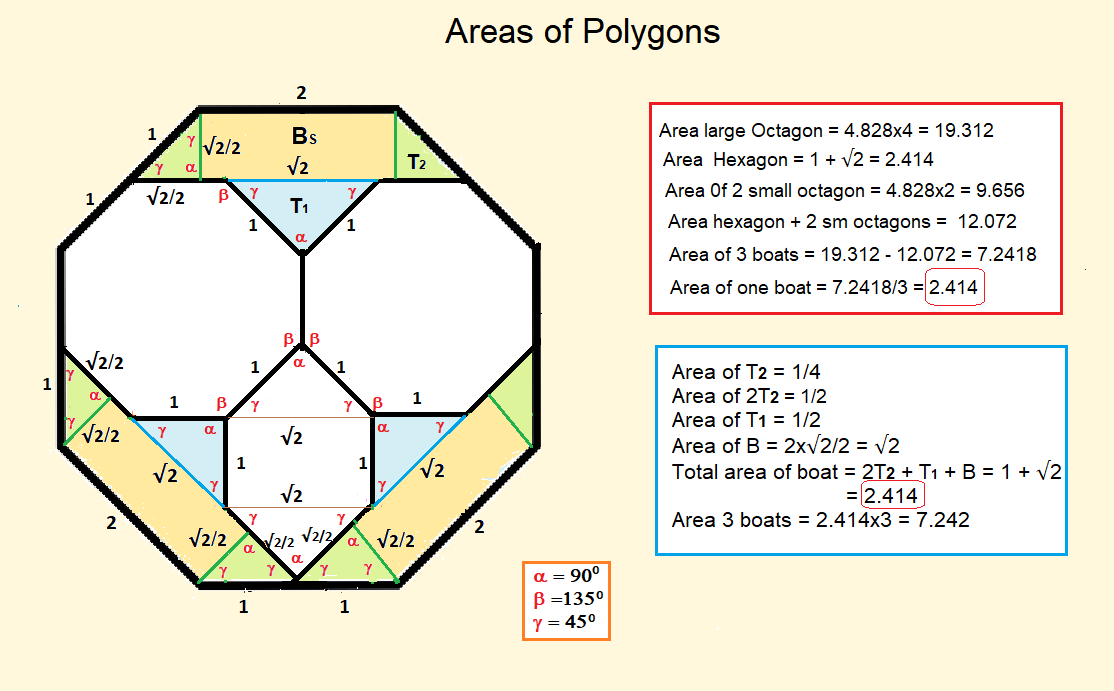
We first place the O2H free structure within an octagon to afford O2H which besides the fused dioctagon/hexagon structure also contains an additional three boats. These boats are all congruent to each other as will be shown below in Octagon Areas Calculation. Performing a recursive subdivision on O2H, via insertion of the O2H free structure affords O2H-1. A second recursion affords O2H-2.:
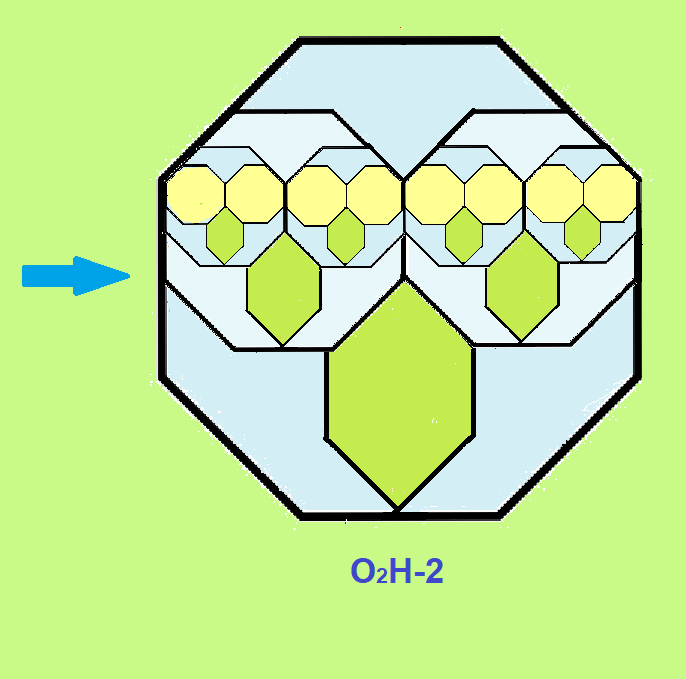
And third and fourth iteration affords O2H-3 (16 small copies of the yellow octagons) then O2H-4 (32 small copies of the yellow octagons) of O2H similar to those found in a Cantor set.
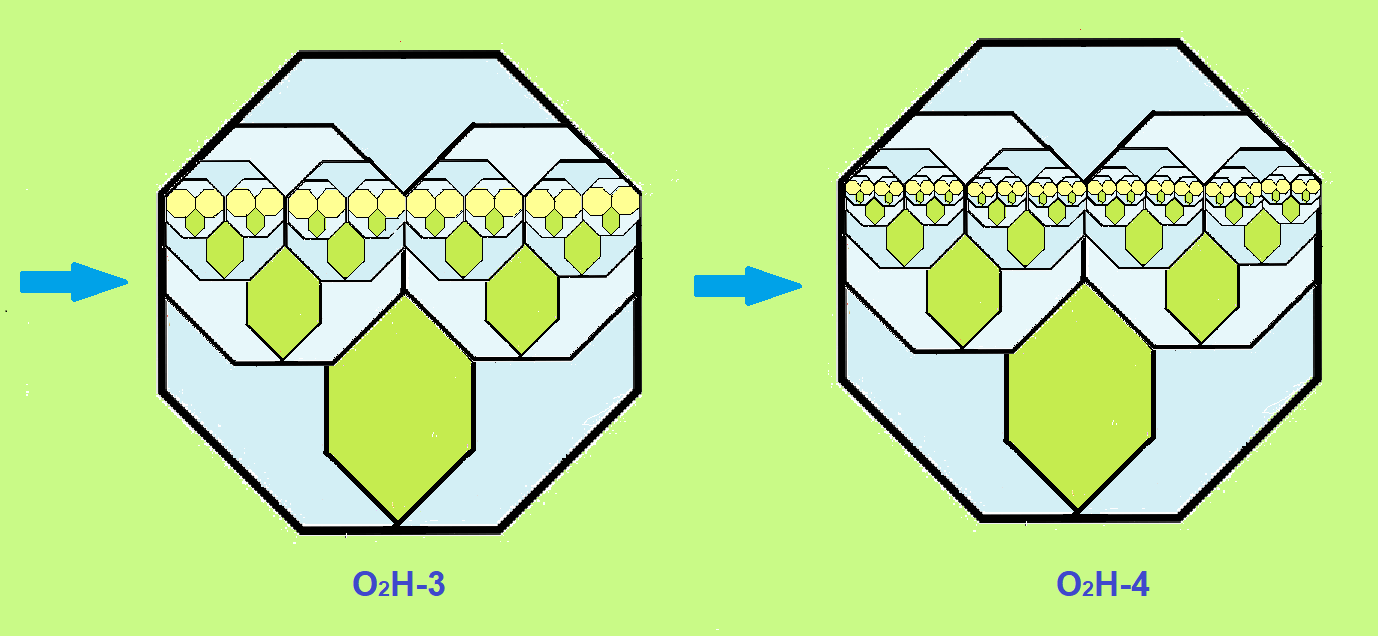
As the figure shows the octagons go off in a straight line in one dimension, while the hexagons, starting with the large one in front, appear to be receding into the distance as in video feedback or the infinite mirror effect.
The calculation of the various polygons in O2H are shown in the following figure. The angles α,β and γ are given for the various structures. In addition, the boats and the hexagon have been broken down into simpler structures such as triangles, square and rectangles in order to simplify the calculations. A boat, for example, is composed of two T2 green triangles, one T1 blue triangle and one Bs light orange rectangle. The calculations for the boat structures have been performed via two different routes giving the value of 2.414 sq units for each thus confirming their congruency. In fact printing out a copy of this figure, cutting out the top Bs boat and superimposing onto the other two boats confirms that they are congruent.
Go to Part IV a recursion of cyclic octagons.
Go back to homepage.
Copyright © 2026 by Eddie N Gutierrez. E-Mail: enaguti1949@gmail.com