The Sierpinski triangle, Wikipedia, is a fractal with the overall shape of an equilateral triangle subdivided recursively into smaller equilateral triangle while the Sierpinski carpet is a plane fractal first described by Waclaw Sierpinski with the overall shape of a square. The scaling factor for the carpet has been shown to be 1/3 the size of previous square, while its Hausdorff dimension of D = log 8/log 3 ≈ 1.8978.
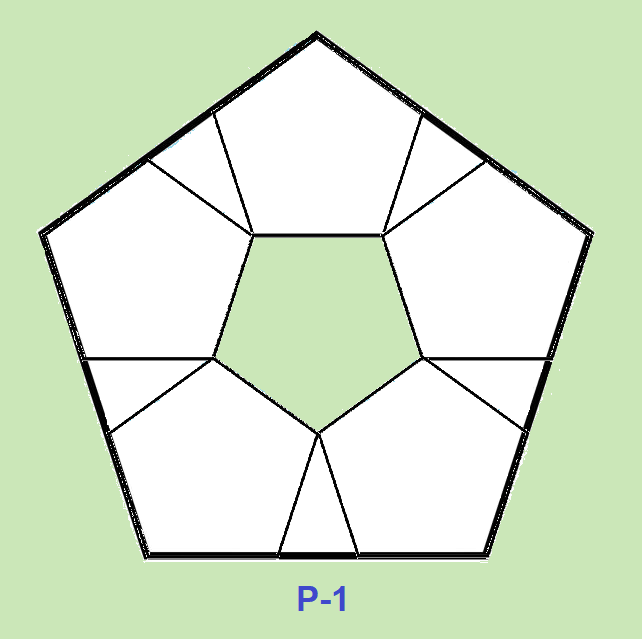
The one constructed here while similar to the original Sierpinski is composed of all pentagons, including the holes. To start six pentagons and five triangles are tesselated within a larger pentagon, with a hole at the central pentagon as shown, within a larger pentagon:
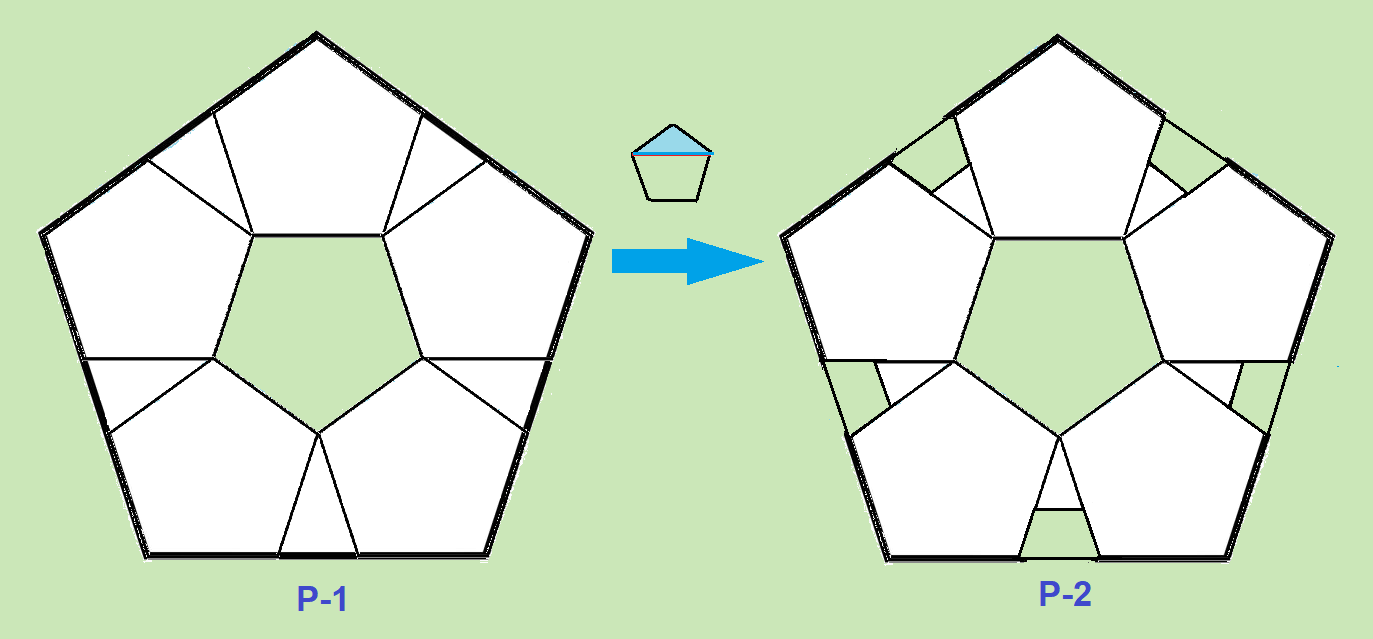
In the next step partially fill in each of the triangles of P-1 with a trapezoidal hole, formed by truncating the blue part of a pentagon with sides = 0.382, as shown in the P-2t triangle, to produce partial holes in the triangles (as opposed to a full hole as has previously been reported) and five smaller white triangles. The result, after the formation of partial holes, is a structure that produces a symmetrical circular type pattern after the first recursion as shown in P-3 , a pattern that is absent when the whole triangle is a hole. In addition, the black boundary of the large pentagon is retained at this trapezoidal hole and which may be deleted.
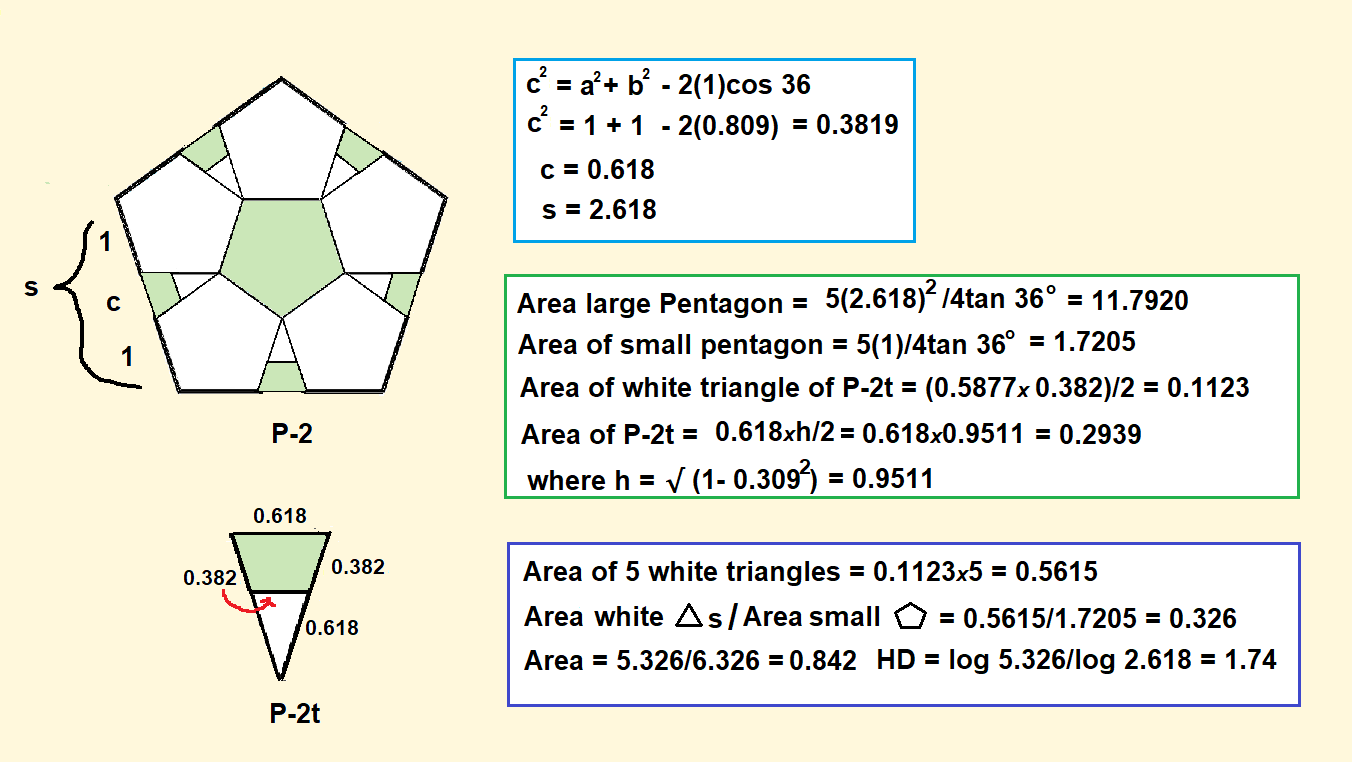
We can determine the various lengths and areas of the smaller pentagons, the larger pentagon and the white triangles as follows:
The areas of all five white triangles is calculated to be 0.5615 which divided by the area of a small pentagon is 0.356 of a small pentagon. Adding this value to the five and six small pentagons affords, respectively, 5.326 and 6.326 as shown in the third inset of the figure.
The area of the (five white pentagons + five triangles) divided by the area of all (six pentagons + five triangles) = 0.842, while the Hausdorff dimension is
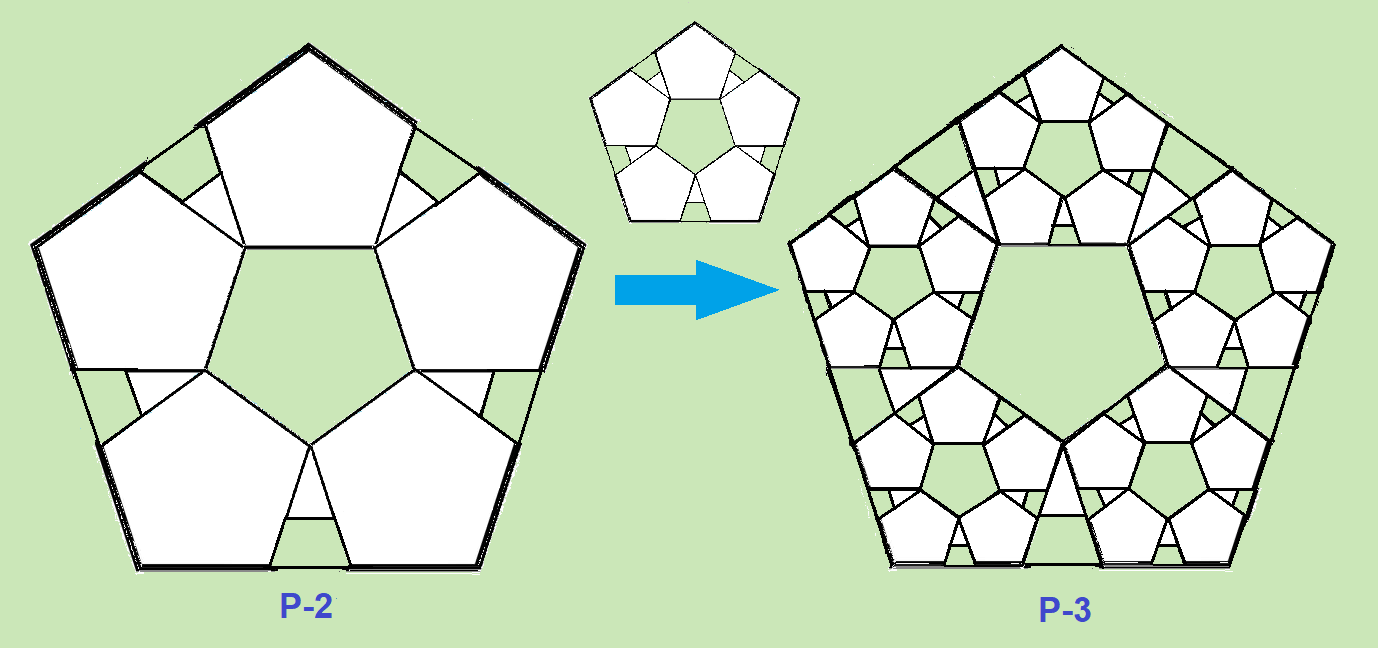
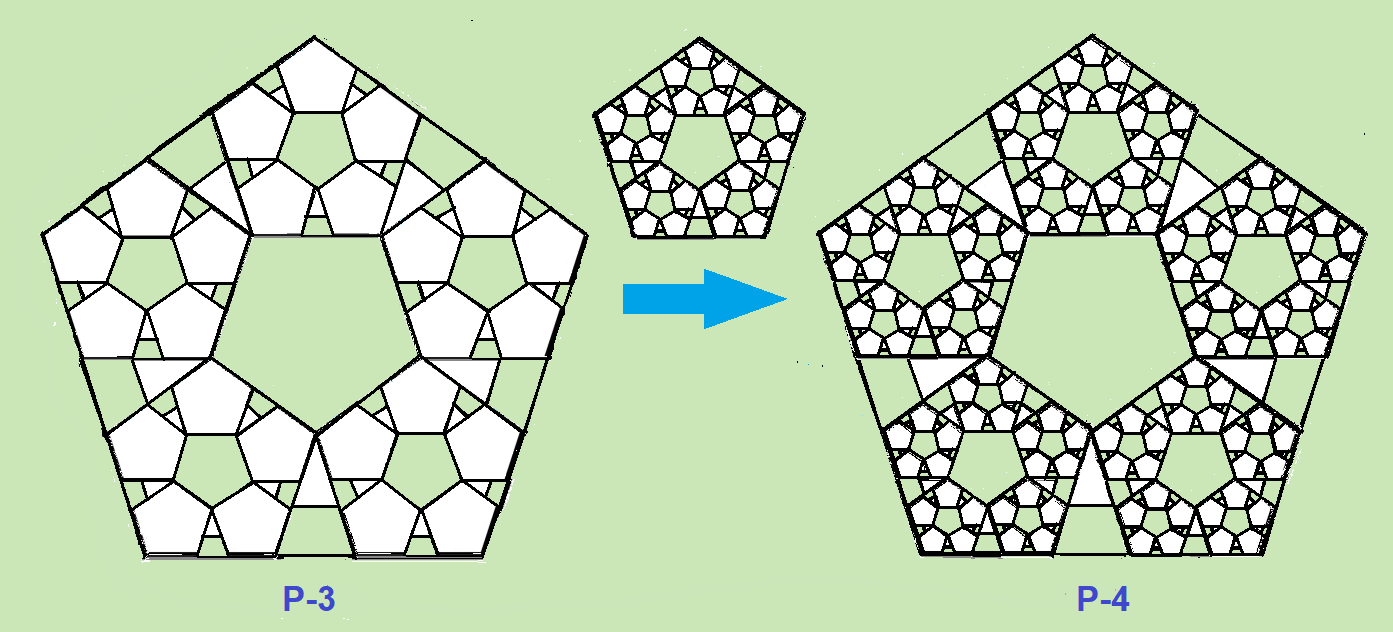
In the first Droste effect, the effect of a picture recursively appearing within itself, recursion can be used to fill in the white pentagons of P-2 with reduced version of P-2 to afford P-3 as shown:
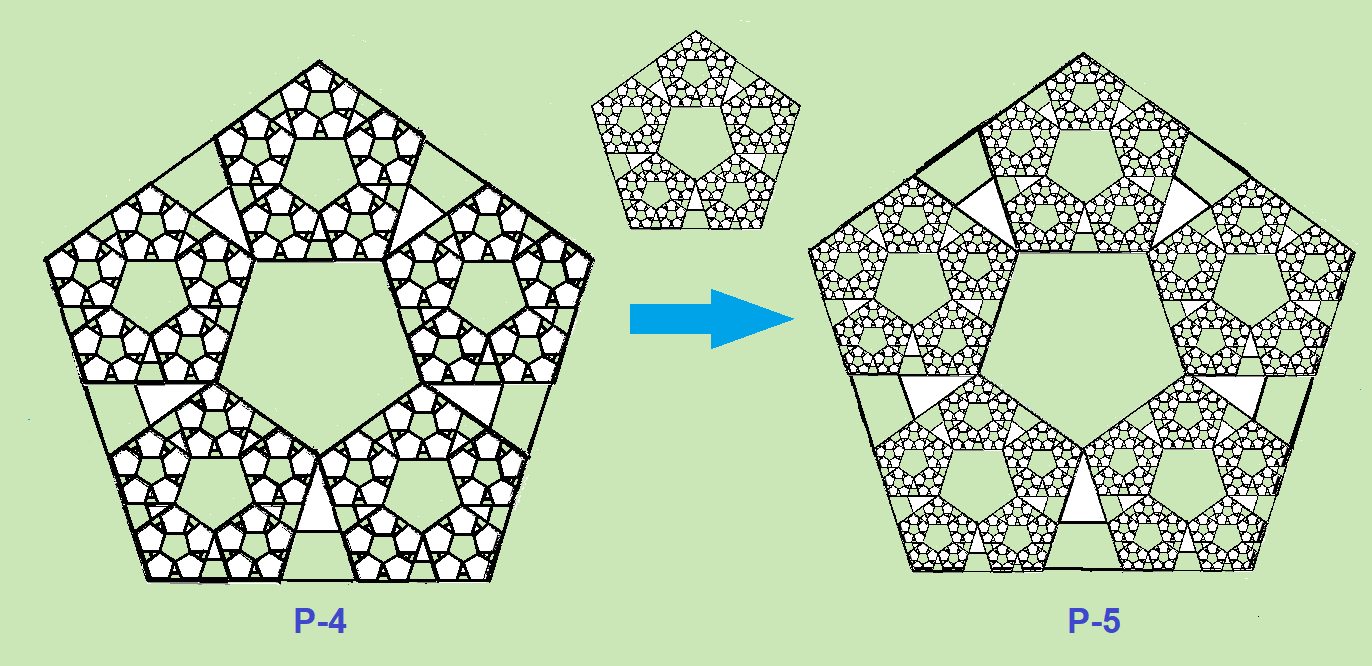
Using a second Droste effect, a reduced version of P-3, shown above the arrow, is used to recursively fill in each small white pentagon of the original P-3 to produce P-4.
Using a third Droste effect a reduced version of P-4 shown above the arrow is used to recursively fill in each small white pentagon of the original P-4 to produce P-5.
Go back to Part II for using the Droste Effect to construct the Sierpinski carpet.
Go back to homepage
Copyright © 2026 by Eddie N Gutierrez. E-Mail: enaguti1949@gmail.com