The Sierpinski triangle, Wikipedia, is a fractal with the overall shape of an equilateral triangle subdivided recursively into smaller equilateral triangle while the Sierpinski carpet is a plane fractal first described by Waclaw Sierpinski with the overall shape of a square. The scaling factor for the carpet has been shown to be 1/3 the size of previous square, while its Hausdorff dimension of D = log 8/log 3 ≈ 1.8978.
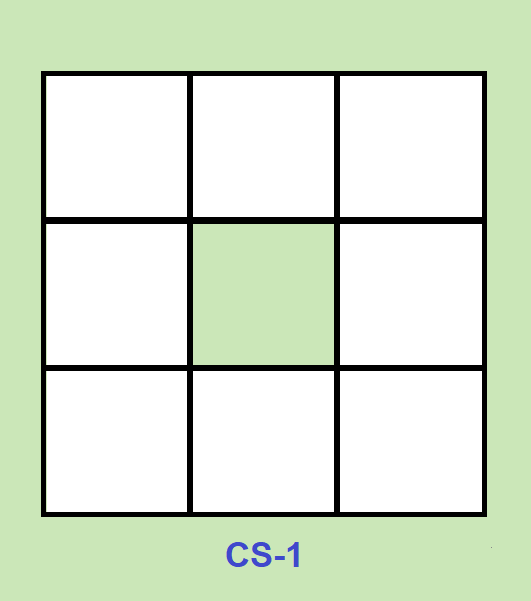
Since a hexagon carpet has been described in Part I via the Droste effect, the effect of a picture recursively appearing within itself, it would be nice to show that the original Sierpinski carpet can also be constructed via this method. We begin by constructing a large square composed of nine smaller squares with a hole at the central square as shown:
Using the Droste we can do a first recursion by taking a picture of CS-1, shrinking it and filling every square of the original CS-1 with this miniature picture to produce CS-2, then following with a second recursion by miniaturizing CS-2 and superimposing onto the original CS-2.
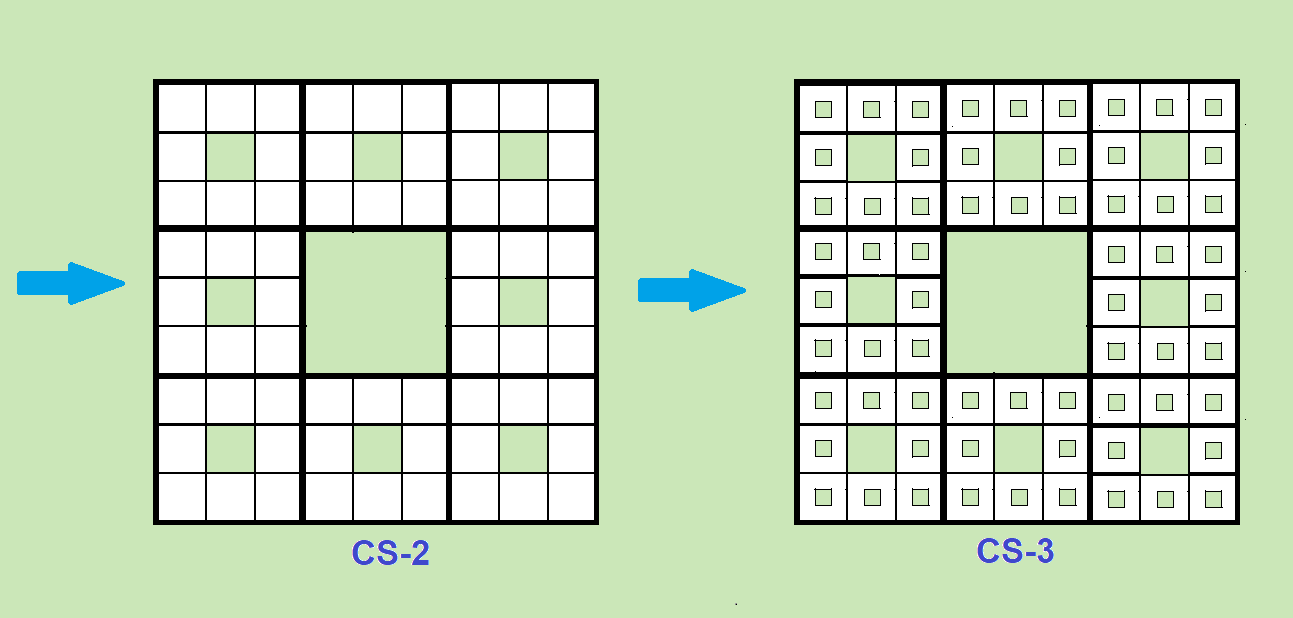
Alternatively, we can minituarize CS-2 and fill in every square of the empty CS-1 with this miniature CS-2 to afford CS-3:
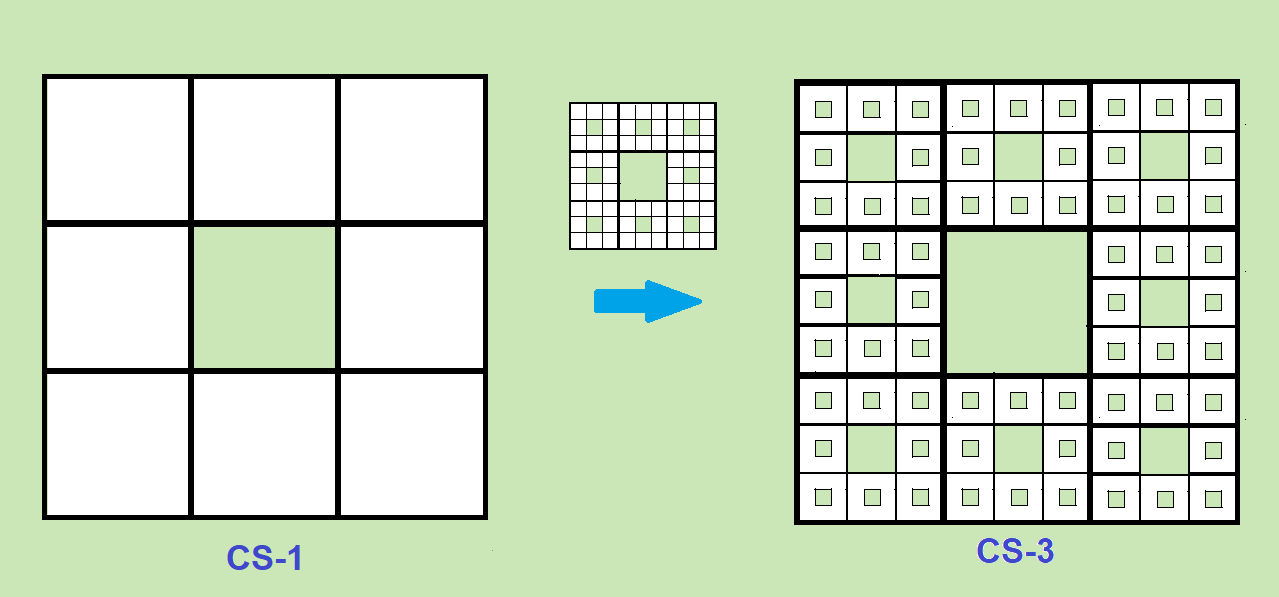
Note that one disadvantage of using the Droste effect in either of these two options is that after the picture is inserted the lines of the miniature square squares must be removed, otherwise there will be a buildup of square lines as the recursion proceeds. I have decided to leave in the square lines from CS-1 and CS-2 but these can also be deleted at the end. The lines are there to aid in centering the miniature squares that are being added to an empty square or being superimposed onto an already filled one.
Performimg a third recursion on CS-3, using a miniature of CS-3 (above the arrow and whose internal square lines have been deleted) where either the miniature is added directly to CS-1 via addition or added by superimposing to CS-3, as shown, affords CS-4:
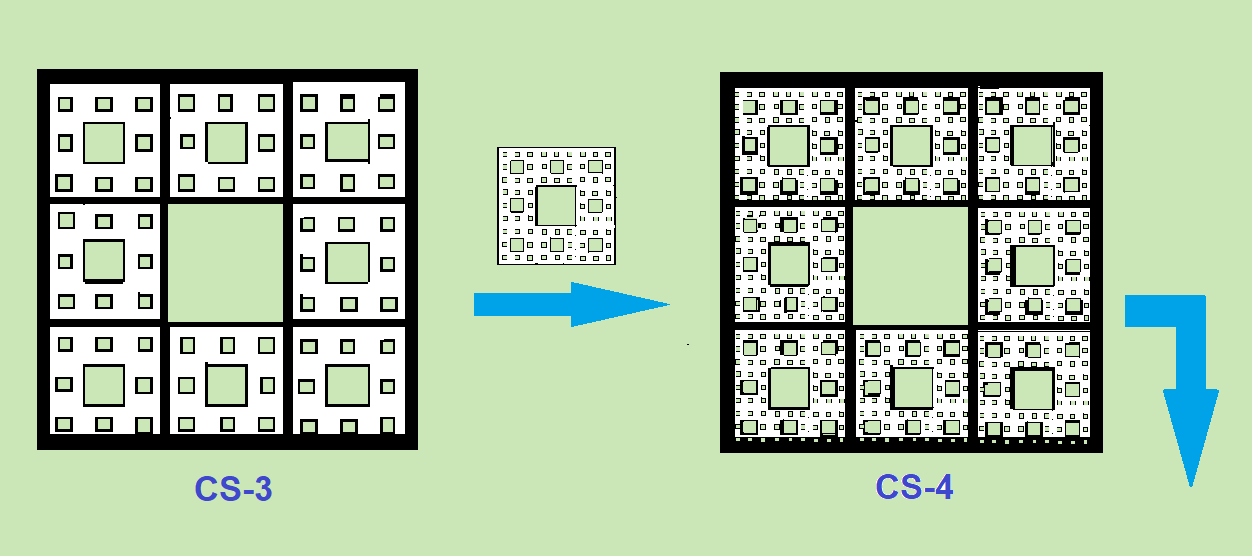
Performing a fourth recursion of a miniature CS-4 on CS-4 itself produces the blown up CS-5, this done so as not to lose the resolution of all the little squares. In addition, a final step would be to delete all the delineated, black, internal squares without removing the green squares.
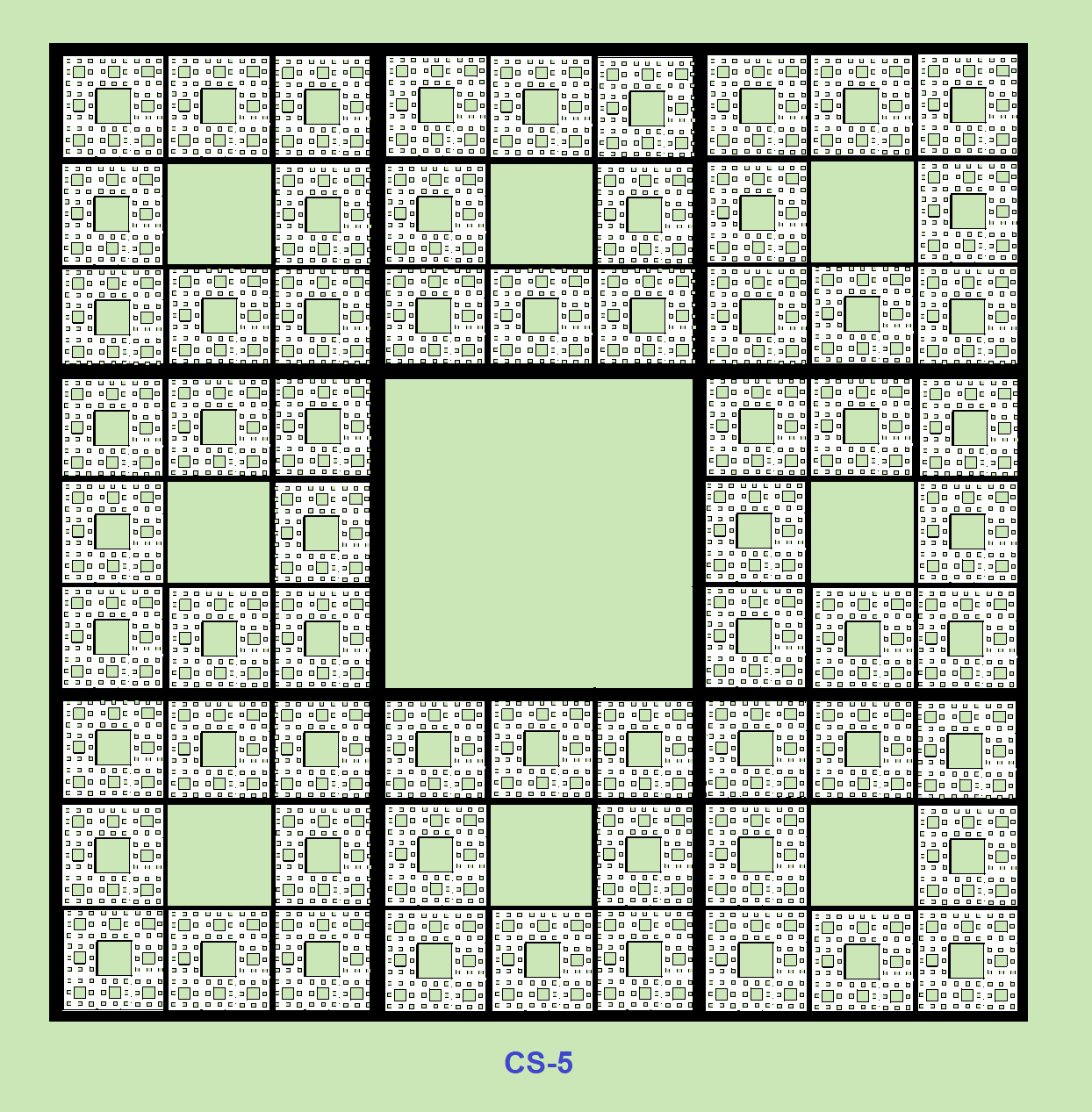
Thus we have shown that we can generate a Sierpinski carpet using the Droste effect. A little more complicated than the general method but still doable.
Go back to homepage.
Copyright © 2026 by Eddie N Gutierrez. E-Mail: enaguti1949@gmail.com